
 English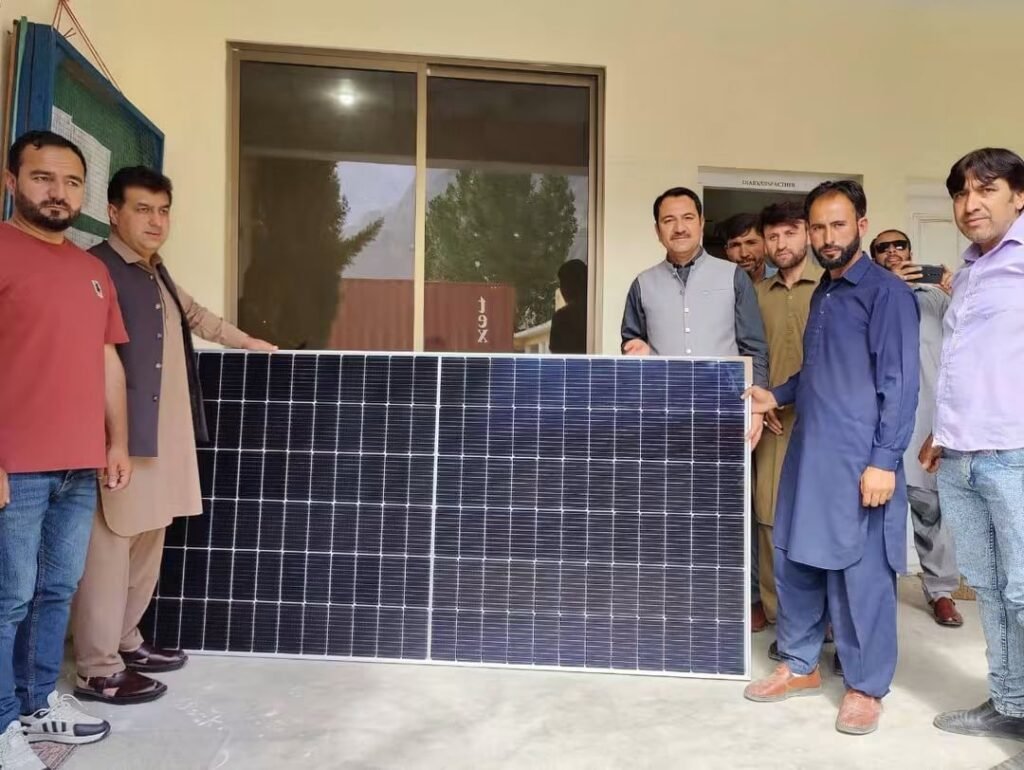



























































THE PANELS THAT FELL FROM A SHIP

By Shabbir Mir
GILGIT: When Karim Baig, a 46-year-old grocer in Ghizer, saw his name on the selected list in April, he closed his shop early and walked home to tell his wife. For years the family has spent its evenings around a single kerosene lamp, his daughters doing homework by its flicker while the village transformer sat silent.
Then came the second piece of news. The panel had arrived, but it was useless on its own. “They told me the panel is free, but the inverter is compulsory and I must buy it,” Baig said, sitting beside the six panels stacked in his courtyard, still in their wrapping. “The battery is my choice, but without it, what do I do at night? Night is when my children study. I have a free panel and I still cannot light one room after dark.”
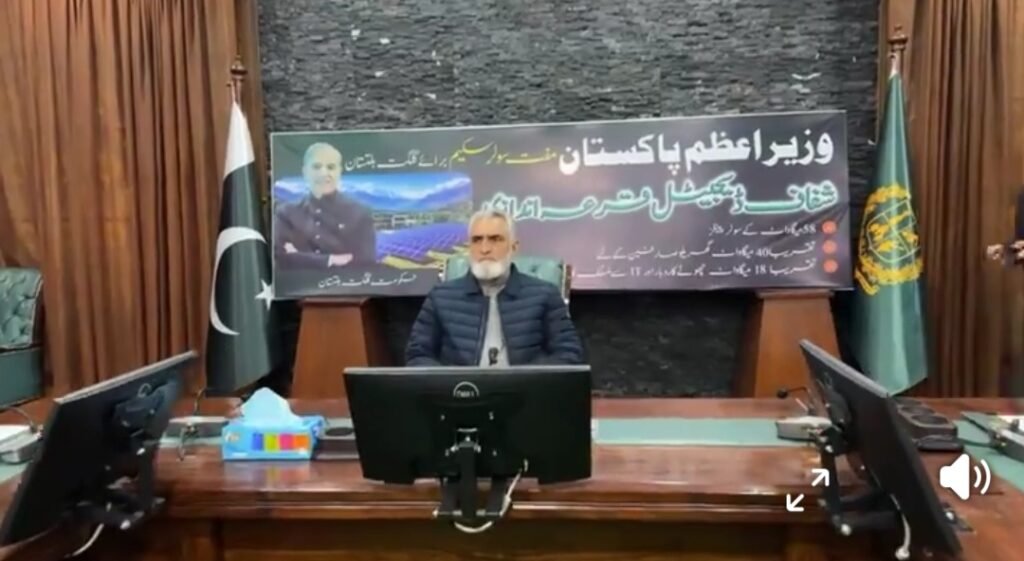
His experience is closer to the norm than the exception. In February, when Prime Minister Shehbaz Sharif’s office announced a free solar scheme for Gilgit-Baltistan, one number made a wave among locals: 147,873, the number of households that media said would receive panels at no cost. Residents here, like the rest of Pakistan, have long been frustrated by unreliable and expensive grid power, which has held back both an equitable energy transition and the region’s development.
At the formal launch in May 2026, Federal Minister for Power Sardar Awais Ahmad Khan Leghari struck a grander note still, saying that “a prosperous Gilgit-Baltistan is the foundation of a prosperous Pakistan.” That number and that sentiment are still the version most people in the region have heard. The scheme’s own portal data now makes the gap between the promise and the reality precise.
What squarely contradicts the “panels at no cost” claim is that beneficiaries in the remote, off-grid valleys must arrange and pay for their own batteries and inverters. Many cannot afford them, which raises doubts about whether the region’s poorest will actually benefit from the “gift” of clean energy.
What Was Actually Approved
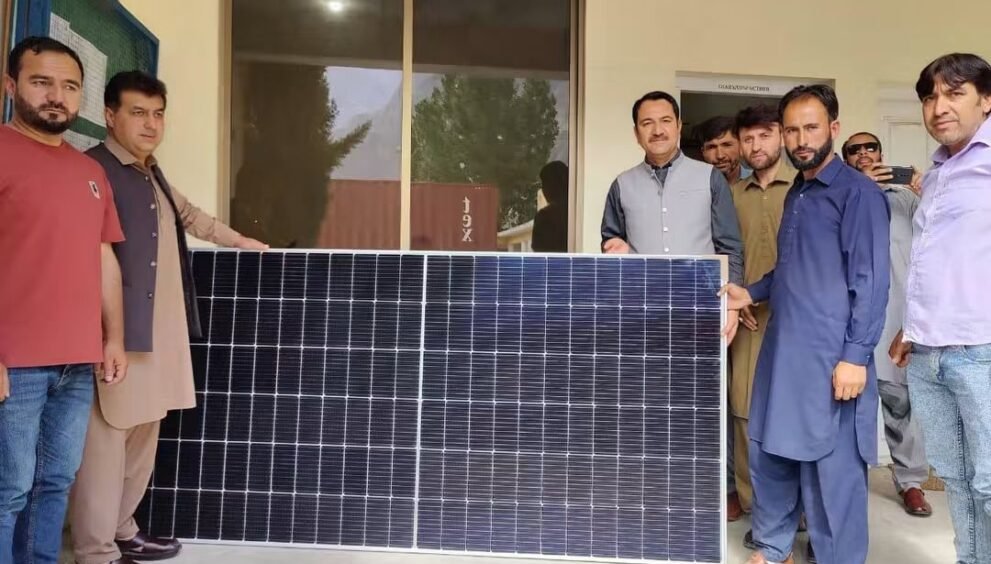
What the Economic Coordination Committee approved in February was the transfer of 144,875 solar panels, with a combined capacity of 58.8 megawatts, confiscated by Customs at Karachi’s ports under the Customs Act of 1969. Rather than auction the seized stock, as is standard practice, the federal government redirected it north.
Moving that stock has cost about Rs 240.1 million, roughly Rs 1,623 per panel. Far from a “free gift”, the Gilgit-Baltistan government was instructed to front the money and recover it from beneficiaries afterward.
The 147,873 figure describes how many households could theoretically be served if every confiscated panel reached a separate home. It was never a delivery commitment, and the scheme’s own district-by-district numbers show it isn’t one.
What the Portal Shows
A district-wise check of the allocation dashboard shows:
| District | Total Applicants | Remaining Applicants | Total kWs Allotted | Remaining kWs | Total Panels | Remaining Panels |
| Astore | 993 | 241 | 2,914.850 | 700.900 | 8,187 | 1,958 |
| Diamer | 2,886 | 269 | 8,806.121 | 768.993 | 22,519 | 1,981 |
| Ghanche | 1,444 | 318 | 3,960.580 | 775.695 | 10,657 | 2,110 |
| Ghizer | 1,830 | 852 | 5,306.035 | 2,497.490 | 13,350 | 6,327 |
| Gilgit | 2,923 | 424 | 12,175.201 | 3,596.111 | 28,141 | 7,484 |
| Hunza | 651 | 95 | 2,222.420 | 328.150 | 6,515 | 963 |
| Kharmang | 580 | 344 | 1,673.470 | 989.205 | 5,987 | 3,694 |
| Nagar | 741 | 152 | 2,254.430 | 454.050 | 7,415 | 1,453 |
| Shigar | 851 | 224 | 2,564.325 | 641.345 | 7,532 | 1,879 |
| Skardu | 2,834 | 806 | 8,443.380 | 2,367.835 | 24,976 | 7,398 |
| Total | 15,733 | 3,725 | 50,320.812 | 13,119.774 | 135,279 | 35,247 |
Three things stand out.
First, the total capacity allotted across all ten districts is 50,320.812 kilowatts, in the same range as the district eligibility list published in March, but below the widely quoted 58.8-megawatt figure from February.
Second, 15,733 applicants have been selected through electronic balloting — a number close to what the Prime Minister himself cited at the May launch, when he told the gathering that more than 50,000 applications had come in and roughly 15,000 beneficiaries had been chosen on merit.
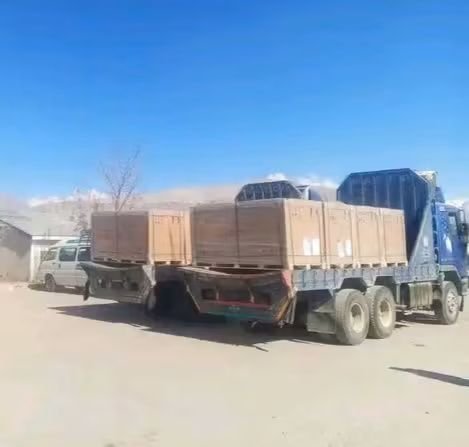
Third, 3,725 of those selected applicants — about a quarter — remain in the “reserved but not issued” column. The dashboard is specific about what this means: remaining allocations are systems that have been reserved for a selected applicant but not yet issued. That is a description of an applicant not having come forward to collect an allotted system, not a department failing to dispatch one. Read that way, the pendency shown in the portal sits on the applicant’s side of the ledger, not the department’s — which raises a different, and arguably more important, question than a supply delay would: why would a selected household not come to collect a “free” panel it has already won?
The gap varies sharply by district. Kharmang has the widest shortfall: 580 selected, 344 still unissued, meaning barely 4 in 10 selected applicants there have collected their systems. Ghizer lags similarly, with 852 of 1,830 selected applicants — nearly half — yet to collect. Diamer and Gilgit, by contrast, show collection rates above 85 percent. One plausible explanation this story could not independently confirm, but which fits every other finding here: households in districts with the steepest additional battery-and-inverter costs relative to income may be the ones most likely to leave a “free” panel uncollected, precisely because collecting it means taking on a bill they cannot yet pay. That is a hypothesis, not a confirmed fact, and it deserves a direct question to the GB Power Department rather than an assumption in print.
By capacity, 37,201 of the 50,320.812 kilowatts allotted have been issued, with 13,119.774 kilowatts still reserved for applicants who have not yet collected their systems. With confiscated-panel stock also awaiting distribution beyond the district quotas, “the scheme is complete” remains an inaccurate description of where the project stands — not because the department has failed to deliver, but because a meaningful share of those who were promised a system have not yet claimed it.
A Deadline, and a Question About Damaged Stock
The most recent official record available for this story confirms that the collection gap above is not a reporting artefact — it is now urgent enough to have its own deadline. On September 28, 2026, the Provincial Steering Committee for the scheme met in Gilgit under the chairmanship of the Chief Secretary, Gilgit-Baltistan, specifically to review “the progress of solar panel distribution and the arrangements for completing the remaining distribution process.” That framing, from the province’s highest administrative body overseeing the scheme, matches this story’s own reading of the portal data: what remains is a collection problem, not a dispatch problem, and it has reached the point of requiring direct intervention.
The Committee’s response was to order a final public notice giving selected applicants exactly one week to collect their solar panels, with a hard deadline of October 4, 2026. The Secretary of the Information Department was directed to publicise the notice widely across print, electronic, social and local media, and Deputy Commissioners in every district were told to facilitate citizens during collection and coordinate closely with district storekeepers.
Two further details from the same meeting add new dimensions to the story. First, Deputy Commissioners were separately directed to submit verified stock details distinguishing undamaged, available panels from damaged panels, for stock reconciliation — the first official acknowledgment that some portion of the confiscated stock sitting in district stores may have deteriorated or been damaged while awaiting collection. Given that beneficiaries are billed retroactively for the transport cost of the specific panel allotted to them, a damaged unit sitting unclaimed raises its own unanswered question: who absorbs that cost if a panel is written off before it ever reaches a rooftop? Second, NATCO was separately directed to ensure timely transport of panels allocated to IT businesses to their respective districts, suggesting the commercial and IT-sector allocation stream has faced its own, distinct transport bottleneck apart from the household track this story has focused on.
With the October 4 deadline falling within days of this piece being filed, its outcome — how many of the roughly 3,725 outstanding allocations are actually collected in that final week, and how many panels are ultimately written off as damaged — is likely to be the single most useful follow-up fact available before publication.
A Region Wired for Scarcity
Gilgit-Baltistan is not connected to Pakistan’s national grid. Its power has long come from small hydropower stations vulnerable to seasonal flow, and from diesel generation that is costly to run in terrain where every litre travels by road through some of the world’s highest mountain passes. Load-shedding here is not an occasional inconvenience. It shapes how households, schools and clinics organise their day.
The federal Power Division has itself acknowledged that successive governments largely neglected the region’s energy needs, an unusually blunt admission from the ministry now running the solar rollout. Federal Planning Minister Ahsan Iqbal has called energy Gilgit-Baltistan’s number one crisis. “The federal government will tackle the power crisis issue and for that matter people need to vote our party to power,” the minister told a gathering before Gilgit-Baltistan’s general elections held in July, which was won by the PPP forming government.
For many in the region, solar is not a lifestyle upgrade but a basic need. Abundant high-altitude sunlight is one of the few resources Gilgit-Baltistan has in surplus. Unlike a transmission line, which would have to cross some of the country’s most difficult terrain, a rooftop panel can be installed almost anywhere.
The Cost of “Free”: Four Public Versions, and One Disputed Claim About the Application Stage
Even for the households whose panels have arrived, what “free” includes has never been a single, consistent story in public statements made after the scheme launched. The record shows at least four official versions.
- Version one, from February’s initial coverage: batteries and inverters are the beneficiary’s own responsibility, along with transport.
- Version two, from later local reporting: the inverter is included in the scheme, but the battery is not.
- Version three, from officials quoted at provincial launch events: the “most deserving” BISP-registered families would receive both battery and inverter at no cost.
- Version four: Former Additional Chief Secretary Mushtaq Ahmed told reporters in Gilgit that the inverter is compulsory, since a panel cannot be used without one, but the battery is a household’s choice, and government funds cover neither. What officials have negotiated, he said, is below-market pricing from vendor companies, not free supply.
None of these versions has been formally retracted or superseded in public statements.
The GB Power Department’s position is that this is a matter of communication after the fact, not a gap in what applicants were told when they applied. According to the department’s clarification: “Applicants were informed, before submitting their form, of the solar system to be provided under the scheme, its capacity, the installation and transport costs, and other terms, so that they would clearly know what facility they were receiving and which costs or responsibilities they would have to bear themselves.” If accurate, that means the application process itself — the form a household filled out before being entered into the ballot — did disclose capacity and cost obligations upfront. What it does not resolve is the inconsistency documented above: the four different public versions of “what’s free” were all statements made by officials after the scheme’s launch, at press events and in media briefings, separate from whatever the application form itself said. A household may have been correctly informed at the point of applying and still have had reason to be confused by what ministers and officials said publicly in the months that followed. Both things can be true at once, and this story treats them as the two separate claims they are rather than collapsing one into the other.
Independent observers see a deeper problem regardless of which version applied at which stage. “When you call something free and then hand the household a bill, people stop trusting the next announcement,” said Shams Rehman, a journalist who has reported on GB issues from Gilgit. “The poorest families are exactly the ones who cannot bridge that gap. A scheme that is honest about its costs can still be a good scheme. A scheme that hides them cannot.”
Two separate costs sit under one word. The Rs 1,623-per-panel charge, fronted by the GB government and recovered from beneficiaries, covers only the confiscated panel’s journey from Karachi. A second, larger cost sits on top: market pricing from mid-2026 puts the logistics surcharge for moving a battery and inverter into GB’s valleys at roughly Rs 12,000 to Rs 30,000, driven partly by the fact that lithium batteries are barred from most domestic flights and must travel by road.
Add the retail cost of a compulsory inverter and, for households that choose one, a battery bank sized to run a house through the evening, and the total a selected household may need to raise on top of the “free” panel can run into hundreds of thousands of rupees.
Imtiaz Hussain, who runs a solar installation shop in Gilgit’s market, said the numbers match what he sees at his counter. “A decent inverter is one price, a battery bank that can carry a home until midnight is several times that, and then freight to Hunza or Kharmang comes on top,” he said. “Families come in with their selection letter, ask for the price, and walk out quietly. Some come back after selling a goat or borrowing from relatives. Many don’t come back.”
That last line, notably, tracks closely with the collection gap the portal shows: applicants who don’t come back to Hussain’s counter with the money may be the same applicants who never come back to collect their “reserved” system at all.
The confusion sits oddly alongside a broader claim the Prime Minister made at a June review meeting, where he reportedly said the federal government would bear all costs of the 58.9-megawatt initiative. Whatever that meant for the scheme’s utility-scale and government-building rooftop components, it has not been reconciled with the household-level reality documented here.
Is a Battery Actually Optional?
A more recent official explainer, circulated after criticism of the battery cost began to spread, makes the strongest public case that a battery isn’t necessary. It frames the scheme against a regional shortfall the government puts at 200 to 250 megawatts, and notes that a single panel retails at roughly Rs 25,000 to Rs 30,000. That makes a 3-kilowatt household system, the scale envisioned for most beneficiaries, an in-kind subsidy of about Rs 140,000.
The system can run directly off daylight through an inverter alone, enough for lights, fans and daytime charging. A battery is needed only to store power for after dark.
Set against Ahmed’s account, this holds up on the battery question but not on the inverter. Ahmed has said explicitly that the inverter is compulsory and not supplied free. Even the “minimal, battery-free” setup the explainer describes requires a household to buy an inverter at whatever rate the government’s negotiated vendors charge, a figure that has not been made public.
There is also a timing problem the explainer does not address. If the region’s power crisis is felt most acutely after dark, a daytime-only system may do comparatively little for the hours when darkness is the problem — the exact complaint Karim Baig raised about his daughters’ evening homework.
After the Panel Goes Up
There is a second, quieter risk that rarely makes it into launch-day coverage: what happens after installation.
Solar hardware is not maintenance-free. Panels need periodic cleaning where dust and, at high-altitude locations, snow are seasonal realities; inverters fail; and batteries degrade within a few years of hard use in a climate that swings between intense high-altitude sun and sub-zero winters.
“Every solar programme I have seen fail did not fail on installation day. It failed in year two, when the first inverter burned out and nobody within 200 kilometres knew how to fix it,” said Naveed Abbas, an engineer who has worked on village electrification projects in the north. “Without trained local technicians, spare parts and a service line, you are not delivering electricity. You are delivering a set of quietly dead rooftop panels, just on a delay.”
No after-sales or maintenance-training component has been publicly announced alongside the scheme.
That gap also holds an opportunity the scheme seems to have neglected. A maintenance network built around local technicians would create the steady, distributed employment that a remote, tourism- and agriculture-dependent economy needs — work that doesn’t require migration to Karachi or the Gulf.
The Larger, Slower Half: Officially Behind, Officially Frozen
Running alongside the confiscated-panel scheme is a second, larger initiative: a 100-megawatt package comprising an 82-megawatt utility-scale solar cluster and an 18-megawatt rooftop programme across 499 government buildings.
An official project status brief dated August 11, 2026, the most detailed accounting of progress to surface publicly, shows this half is further behind and more expensive than earlier statements suggested, and that key parts of it have stopped moving entirely.
As of August 11, physical progress stood at 3.0 percent and financial progress at 2.5 percent. The PC-I was approved by the Executive Committee of the National Economic Council (ECNEC), the high-level body that reviews and approves major public-sector development projects, in August 2025, and administrative approval followed in November 2025.
The brief also resolves a cost discrepancy that has dogged reporting on the scheme. The PC-I approved by ECNEC was costed at Rs 24,956.76 million, the figure later cited, rounded, at the Prime Minister’s Committee meeting on September 3. Since then, the 82MW utility-scale portion alone has been revised upward to Rs 32.424 billion, after the brief cites the “complexity of the Communication and Control Strategy” as extending timelines and requiring a revised feasibility study.
In other words, Rs 24.9 billion and Rs 32 billion were never competing estimates of the same thing. The true combined cost of the full 100MW project is now higher than either figure alone, and no public document reviewed for this story states it as a single number.
The utility-scale site plan has also changed. What was once a single 82MW cluster is now four sites:
- Bunji: 58MW with 20MWh of battery storage, serving Gilgit, Hunza, Nagar and Ghizer.
- Chilas: 8MW with 10MWh storage.
- Skardu: 6MW with 10MWh storage.
- Khaplu: 10MW with 10MWh storage.
That is a combined 50MWh of battery storage, short of the 66.1MWh cited in earlier project announcements. Expected completion remains December 2027.
The brief’s most consequential line is that the Prime Minister has directed the executing and sponsoring agency for most of the project’s components be transferred from GB’s Water and Power Department to the federal Power Division and PPIB.
The rooftop portion shows the same slippage in more granular form. Each of its three lots has already missed its original completion date:
- Lot-I, Gilgit region: 9.11 MWdc across 236 buildings, originally due October 24, 2026, now expected December 13, 2026.
- Lot-II, Baltistan region: 5.70 MWdc across 175 buildings, originally due September 9, 2026, now expected October 29, 2026.
- Lot-III, Diamer-Astore region: 3.34 MWdc across 88 buildings, originally due July 24, 2026, now expected February 2027.
Commencement orders have been issued and contractors mobilised for Lots I and II, with system design still underway. Procurement of an EPC contractor for Lot-III, like the utility-scale component, has been halted pending the agency transfer.
Funding has been partial. Rs 4 billion was allocated and released for FY2025-26, and Rs 5.709 billion is allocated for FY2026-27. That is a combined Rs 9.7 billion against a project whose utility-scale portion alone is now costed at over Rs 32 billion. A steering committee chaired by the Federal Minister for Power has met 14 times.
Underneath all of this sits the absence of an NFC Award-style financing framework for Gilgit-Baltistan, which Iqbal flagged on September 3 as still unresolved. “Energy is the number one crisis in Gilgit-Baltistan,” he told the same meeting — a line that reads less like reassurance than an admission of how much remains undone, set against a project that is, by the government’s own account, not yet complete a year after approval.
The Honest Frame
“One day the inverter will come. I only hope my children are not grown by then.” — Karim Baig, grocer, Ghizer
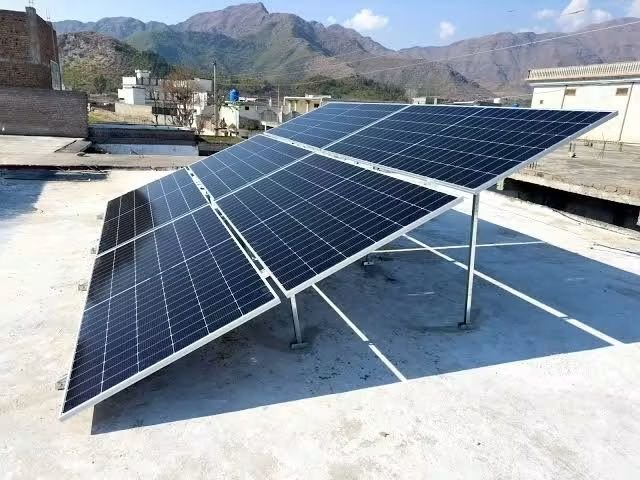
Back in his courtyard in Ghizer, Karim Baig is still waiting. The panels are stacked against the wall, and the kerosene lamp is still what it has always been — a small, stubborn hope, especially with winter coming. “One day the inverter will come,” he said. “I only hope my children are not grown by then.”
Pull the threads together, and the fair summary is neither the celebratory one in February’s coverage nor a simple story of official failure. Pakistan did redirect seized panels instead of auctioning them off — that is real, and unusual as public policy goes. A digital lottery, whatever its flaws, is a genuine improvement over the discretionary distribution lists that have marred past subsidy schemes in the country. And the GB Power Department’s account — that applicants were told the terms upfront, and that the uncollected allocations reflect households not yet able or willing to claim them — deserves to stand alongside, not be erased by, the confusion documented in the months of public statements that followed.
But a scheme announced as free power for nearly 148,000 of the region’s underserved has, in practice, delivered to roughly a tenth of that number, left a further quarter of even that smaller group without a reason on record for why they haven’t collected their allotted systems, and produced four different public accounts — after the fact — of what “free” actually means. The grid-scale half of the project that would carry power through the night is, by the government’s own internal accounting, three percent complete a year after approval, with its true combined cost never stated as one figure and its third-party validation process halted before it began. Awais Leghari called a prosperous Gilgit-Baltistan the foundation of a prosperous Pakistan. On the evidence gathered here, the foundation is still barely poured, and the family deciding whether it can afford to collect the “free” panel it already won is the same family the scheme was announced to help.